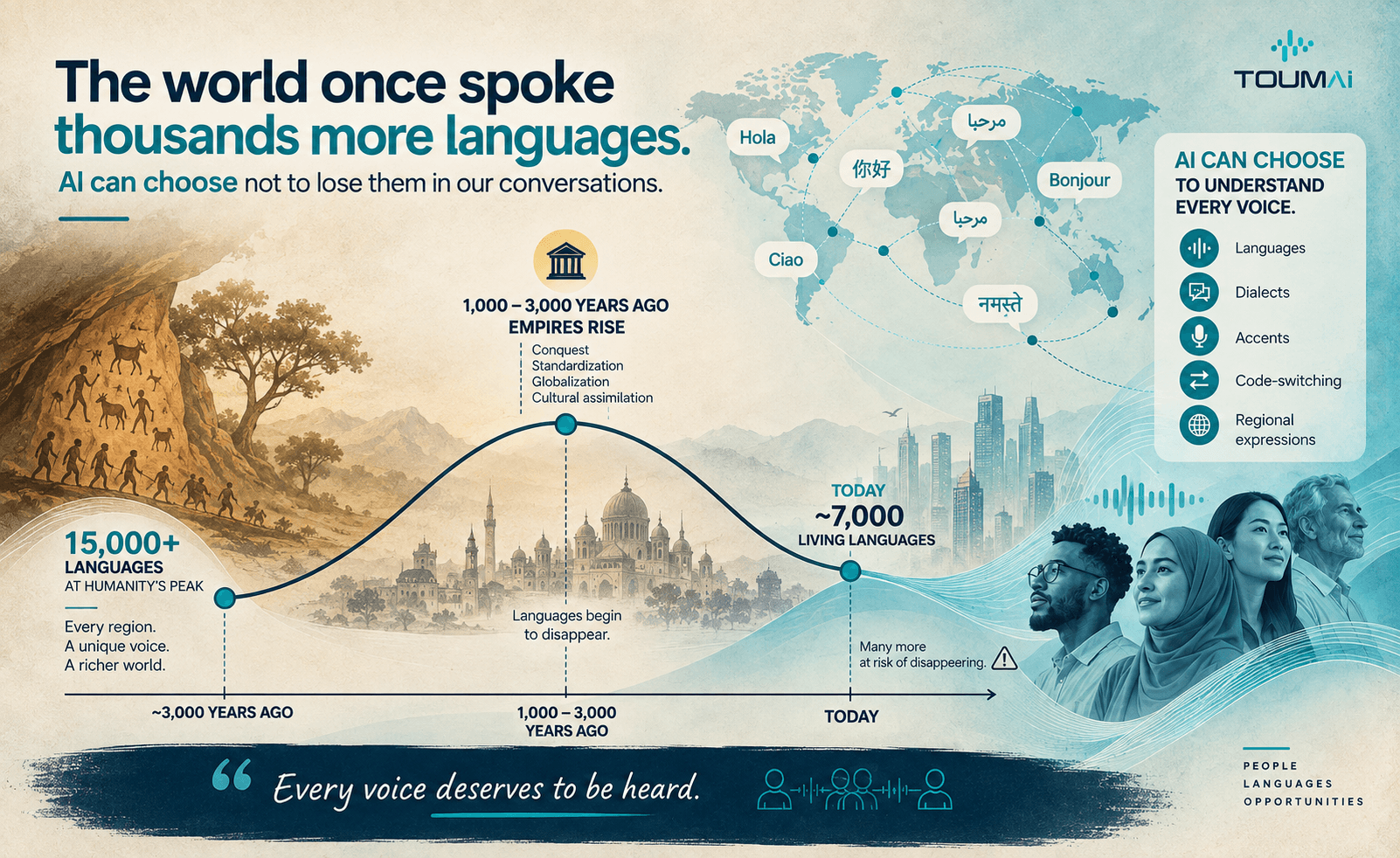
One Language, Different Voices: What Spain and Argentina Teach Us About Voice AI Localization
Spain and Argentina both speak Spanish, but not the same way. See why dialect-aware Voice AI beats generic multilingual support for CX.

One Language, Different Voices: What Spain and Argentina Teach Us About Voice AI Localization
Dialect-Aware CX for Multilingual Markets
When Spain beat Argentina 1–0 in extra time to win the 2026 FIFA World Cup Final this July, millions of fans on both sides celebrated, commiserated, and argued with the referee,
all in Spanish. Just not quite the same Spanish.
Spanish connects millions of people across countries and continents. A customer in Spain and a customer in Argentina may select the same language when they contact a business, yet the conversations that follow can sound noticeably different.
The accent changes. Pronunciation shifts. Grammar and expressions vary. The rhythm of conversation carries the influence of the region and the people who live there.
For people, these differences are completely natural.
For Voice AI, they reveal an important challenge: recognizing a language is not the same as understanding the person speaking it.
This is the gap ToumAI's Voice AI is built to close: recognizing not just that a customer is speaking Spanish, but which Spanish they're speaking, and adjusting the conversation to match.
One Language Doesn't Mean One Way of Speaking
Most digital experiences still approach language as a relatively simple choice. Once the language has been identified, it can seem as though the biggest localization challenge has been solved.
But real conversations are more complex. Two people can speak the same language while using it differently because of where they live, how they learned it and how people around them communicate.
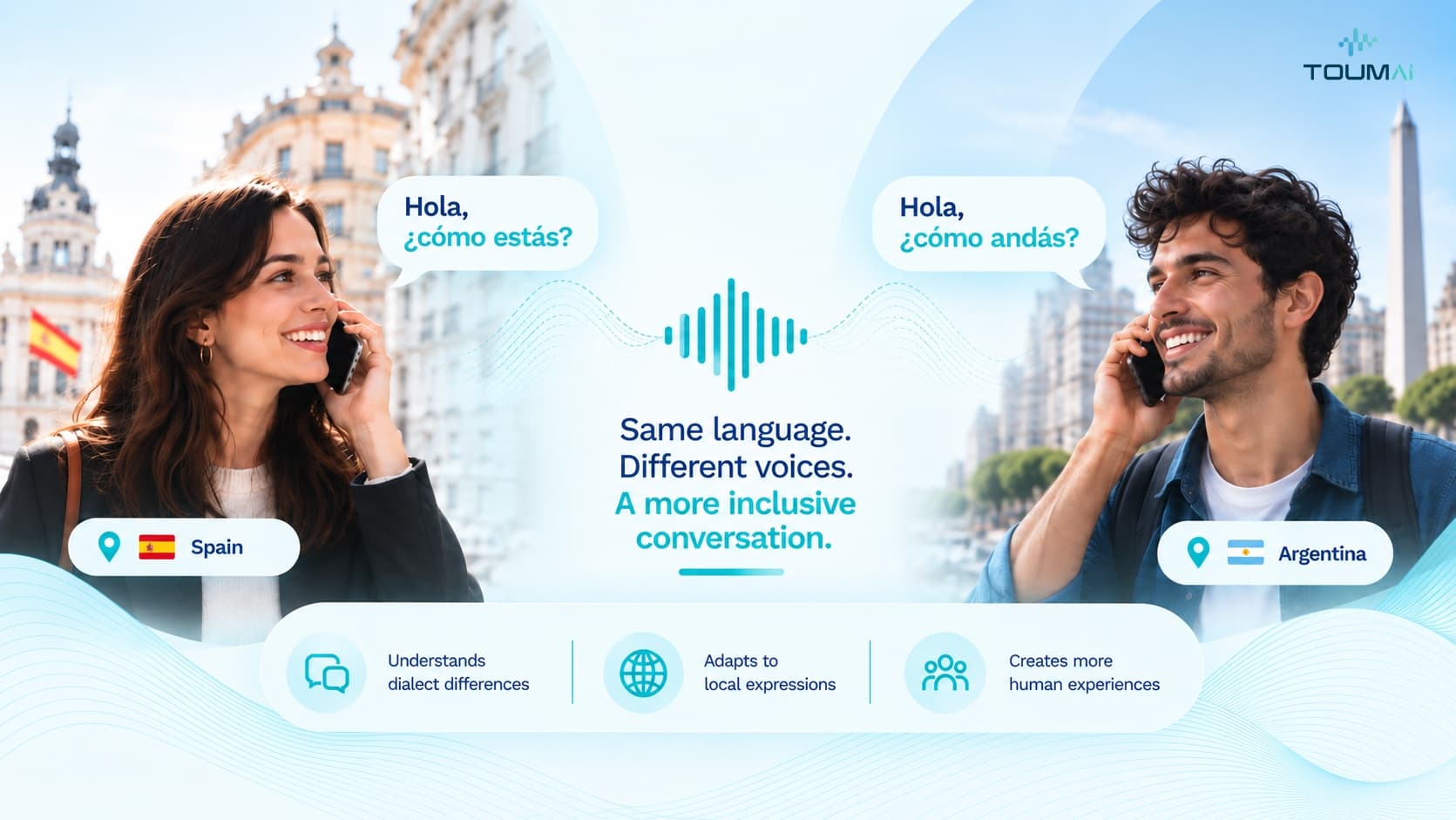
Spain and Argentina are a good example. The language remains Spanish, but regional pronunciation, grammatical patterns, forms of address, expressions and conversational rhythms can differ.
In Spain, a customer might address a company representative using "tú"; in Argentina, that same customer would use "vos" instead, changing the verb entirely. Some words go further still — the same word exists in both countries but carries a different meaning altogether:
Spain | Argentina | |
|---|---|---|
Second person singular | "tú tienes" | "vos tenés" |
"Manejar" | Mainly means "to manage/handle" | Commonly used for "to drive" |
"Torta" | Means "cake" | Can also mean "a slap in the face" |
That last one is worth sitting with: the same word can carry two very different meanings depending on where the speaker is calling from a distinction a generic speech system has no way to catch.
Neither version is more correct. They simply reflect how language develops naturally within different communities.
And when customers interact with a business, they don't leave those differences behind. They bring them into every conversation.
Customers Don't Speak in Language Settings
Imagine someone calling their bank, insurance provider, or telecom operator.
They aren't thinking about the speech model behind the service. They aren't wondering whether their pronunciation matches the version of Spanish the system was trained to recognize. They simply speak.
A customer might talk quickly, use a strong regional accent or phrase something in a way that is common in their local community. In multilingual environments, they might even move between languages during the same conversation.
To the customer, none of this is unusual. They expect the system to follow.
When it doesn't, friction begins. The AI asks them to repeat themselves. The customer tries again. They slow down or change the way they normally speak. The system may misunderstand their intent. Eventually, a simple interaction can turn into an unnecessary transfer to a human agent.
Technically, the system supported the customer's language. But did it really understand the customer? That's the more important question.
A Small Misunderstanding Can Become a CX Problem
A single misunderstanding may not seem significant. At scale, it can become an operational problem.
When customers have to repeat themselves, conversations become longer. When the system repeatedly fails to understand an intent, more interactions are transferred to agents. Those transfers add pressure to customer service teams while increasing the time customers spend trying to resolve relatively simple requests.
The result can be a familiar chain reaction:
Misunderstanding → repetition → longer interaction → agent transfer → frustrated customer.
For enterprise CX teams, this means language understanding isn't simply a linguistic challenge. It can influence efficiency, customer satisfaction and the overall quality of the experience.
That's why measuring multilingual capability only by asking "How many languages does the system support?" tells only part of the story. A better question is: how well does the system understand the different people speaking those languages?
Localization Has to Move Beyond Translation
Traditional localization has often focused on what customers see. Translate the website. Adapt the interface. Localize the content. Offer the right language option.
Voice introduces another layer. Now localization has to work inside the conversation itself.
A localized Voice AI experience needs to account for regional pronunciation, dialects and the ways multilingual speakers naturally communicate.
It also needs to deal with code-switching. A customer may begin a sentence in one language, use a familiar expression from another and then continue the conversation without thinking twice about it.
For the customer, that's simply communication. For a generic speech system, it can be considerably harder to interpret.
This is where the distinction between multilingual and dialect-aware Voice AI becomes important — and it's the problem ToumAI was built around. Rather than bolting dialect handling onto a generic model after the fact, ToumAI fine-tunes on dialect-specific data from the start, so regional phonology and code-switching are part of how the system understands a conversation, not an exception it has to work around.
Dialect-Aware Voice AI vs. Multilingual Voice AI
Supporting a language expands coverage. Understanding variation within that language improves the conversation — and these are not the same capability.
A multilingual system can correctly identify that a call is in Spanish, French, or Arabic. A dialect-aware system goes further: it recognizes that Spanish in Madrid and Spanish in Buenos Aires carry different pronunciation and phrasing, and it adjusts accordingly without asking the customer to repeat themselves or slow down.
Spain and Argentina make that distinction easy to see because both customers can be speaking Spanish while bringing different regional characteristics into the interaction. A system may correctly identify both conversations as Spanish and still perform differently when processing each speaker.
That creates an important challenge for businesses operating across markets. Customers don't want to know which speech model is processing their call. They don't care whether their regional pronunciation appeared frequently enough in a training dataset. They simply expect the conversation to work.
And when it doesn't, the burden shouldn't fall on them to change the way they speak. They shouldn't need to slow down unnaturally. They shouldn't need to avoid regional speech. They shouldn't need to switch to a more "standard" version of their language just to complete a task.
The technology should adapt to the customer, not the other way around.
What Spain and Argentina Really Teach Us
The lesson isn't simply that Spanish sounds different in different countries. It's that language is deeply connected to place, culture and everyday life.
The same principle applies far beyond Spanish. Languages evolve differently across regions. Dialects develop. Accents change. Communities create their own conversational patterns. Multilingual speakers combine languages naturally.
For Voice AI, these aren't unusual edge cases. They're part of real communication. And that changes what meaningful localization should look like.
Instead of designing Voice AI around an idealized version of how a language should sound, businesses need systems capable of working with how their customers actually speak.
That's the difference between recognizing a language and understanding a conversation.
Where ToumAI Comes In
At ToumAI, this challenge sits at the foundation of how we approach Voice AI.
Rather than treating dialects as an additional layer added after language recognition, ToumAI's architecture is designed around dialect awareness, with models fine-tuned on dialect-specific data to capture regional phonology and code-switching that generic models can miss. In practice, this is what lets a ToumAI-powered agent handle a call that shifts between Maghreb French and Darija mid-sentence, or a customer who moves between Peninsular and Latin American Spanish, without asking them to repeat themselves reducing the unnecessary escalations that generic multilingual systems create.
This foundation supports ToumAI's conversational Voice AI and customer-experience products, with the goal of making real customer conversations easier to understand across multilingual markets.
The objective isn't to teach customers how to speak to AI. It's to build AI that can better understand how customers already speak.
For businesses operating across markets, that means moving beyond simply adding languages to a system. It means considering the accents, dialects, regional speech patterns and code-switching that shape everyday customer conversations.
Because speaking your customer's language is only the beginning. Understanding their voice is what makes the conversation work.