The World Once Spoke Thousands More Languages. AI Can Choose Not to Lose Them.
History has been quietly narrowing language for centuries, standardizing speech and retiring dialects. AI is the first technology that doesn't have to repeat that pattern.

The World Once Spoke Thousands More Languages. AI Can Choose Not to Lose Them.
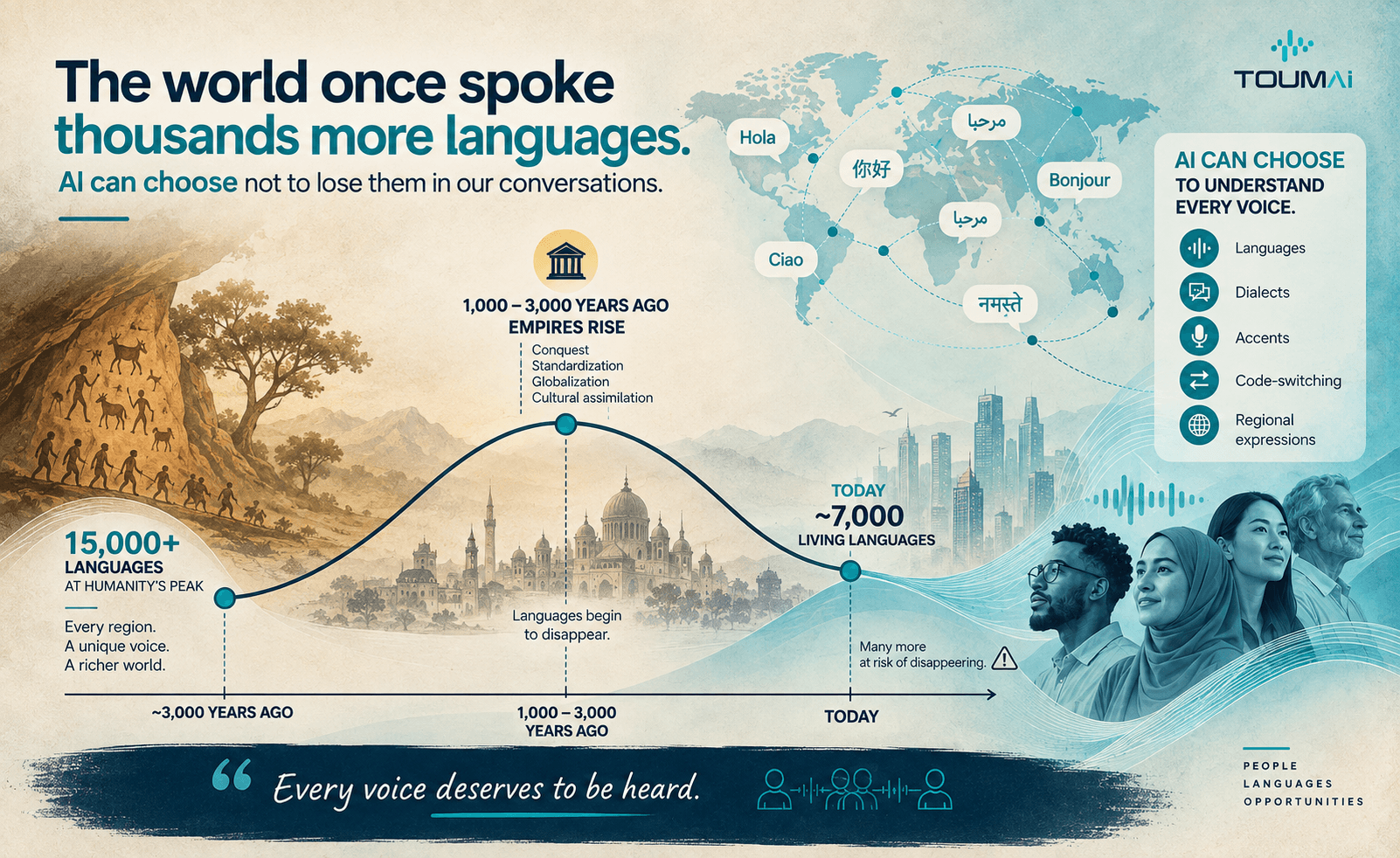
Three thousand years ago, walking from one valley to the next could mean walking into a different language entirely. Linguists estimate that at humanity's peak, somewhere around 15,000 languages were spoken across the world, each one shaped by a specific place, a specific history, a specific way of understanding the world.
Today, roughly 7,000 remain. Empires standardized speech. Trade routes rewarded whoever spoke the dominant tongue. Schools taught one "correct" version and quietly retired the rest. None of this happened all at once, and none of it was really a decision. It was just what happened when the world got smaller and languages had to compete for space.
That process isn't finished. It's just changed shape. And right now, it's happening again, this time inside AI.
Dialects don't disappear all at once. They disappear quietly.
Nobody wakes up one day and decides to stop speaking the way they grew up speaking. It happens in smaller moments: a job interview where the "professional" accent gets rewarded. A customer service line that only recognizes the textbook version of a language. A voice assistant that keeps asking you to repeat yourself until you give up and say it the way it wants to hear it.
Every one of those moments sends a small signal: this way of speaking doesn't count here. Multiply that by millions of interactions, and you get exactly the kind of quiet standardization that shaped language history in the first place. Except now, it's not empires doing it. It's software.
Here's the part that should give any company pause: most Voice AI wasn't built to notice this happening. It was built to understand a language, not the dozens of ways real people actually speak it.
The next language barrier isn't translation. It's recognition.
A customer in Zurich doesn't speak "German." They speak Swiss German, a way of speaking with its own vocabulary, rhythm, and pronunciation that has very little in common with the standardized written German most systems are trained on. A customer in Naples speaks Neapolitan. A customer in Glasgow speaks Scots. Three completely different everyday ways of speaking, all technically filed under a bigger "official" language, all functionally invisible to a system that only recognizes the "standard" version.
It's not the only region where this happens. A customer in Antwerp speaks Flemish, not textbook Dutch. A customer in Barcelona might answer a call in Catalan, not Castilian Spanish. A customer in Marseille carries an accent and vocabulary that a call center built for Parisian French was never designed to expect.
None of these are accents layered on top of a "real" language. They are the real language, as far as the person speaking it is concerned. When a system can't recognize that, it's not a minor gap. It's the difference between a customer feeling understood and a customer repeating themselves for the third time before giving up.
AI has a choice history never had.
Here's what makes this moment different from every wave of standardization before it: technology has never had the ability to adapt to how people actually speak at scale. Printing presses couldn't do it. Broadcast media couldn't do it. Even the first generation of voice technology couldn't really do it. It needed everyone to meet it halfway, speaking clearly, slowly, and as close to "standard" as possible.
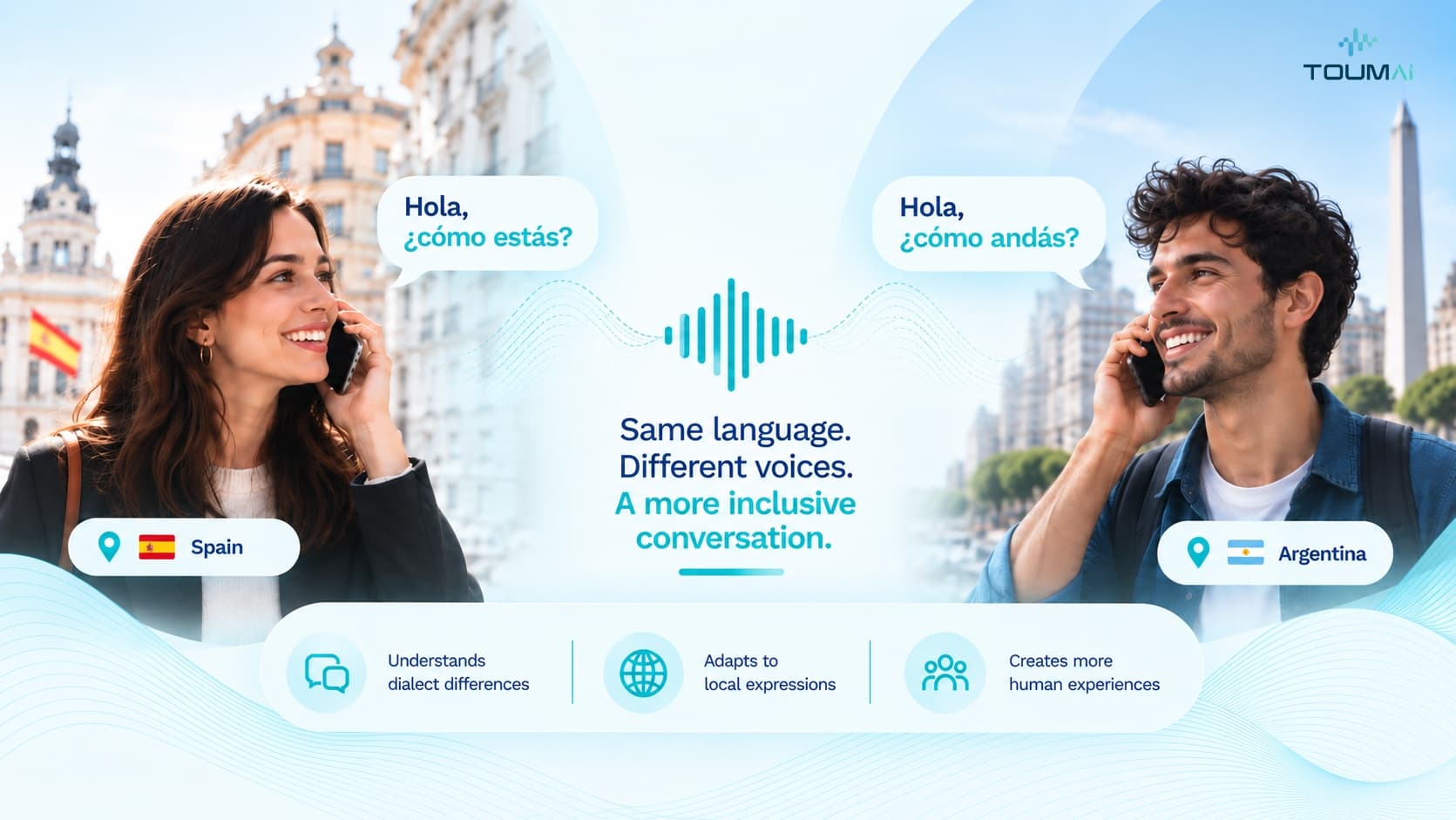
Machine learning changes that math. A model can be trained on Swiss German specifically, not as a variant of Standard German, but as its own thing, with its own patterns. It can learn what code-switching sounds like when a customer in Brussels moves between French and Flemish mid-sentence, instead of choking on it. For the first time, the technology can do the adapting, instead of asking the person on the other end of the line to.
That's not a small technical detail. It's a genuinely different relationship between technology and the people using it: one where the burden of "speaking correctly" doesn't sit entirely on the customer anymore.
That's the problem we built ToumAI to solve.
Most of the industry still talks about this in terms of language coverage: "we support 100 languages," as if that settles it. We think that's the wrong question. The right question is: how do people in this market actually speak?
That question is why ToumAI's models are trained on dialect-specific data rather than treating dialects as a rounding error on top of a standard language. It's why code-switching (someone moving between two languages in the same sentence, which is just how people across EMEA actually talk) isn't an edge case in our system, it's expected behavior. It's why we built for the markets and dialects other platforms treated as an afterthought, instead of starting with whichever language had the most training data already available.
A bank in Zurich doesn't need standard German, it needs Swiss German. A telecom provider in Antwerp doesn't need textbook Dutch, it needs Flemish. That's not a nice-to-have layered on top of "real" Voice AI, for these markets, it's the only version that actually works.
History standardized languages because no one had a better option. AI doesn't have that excuse.
Every voice deserves to be heard, not just recognized
There's a difference between a system that can transcribe your words and one that actually understands how you talk. The first is a technical achievement. The second is what makes someone feel like they're talking to something that gets them, not routing them into a translation of themselves.
Language history is a story of things narrowing: fewer languages, fewer dialects, fewer accepted ways of speaking. For the first time, the technology shaping the next chapter of that story doesn't have to narrow anything. It can do the opposite. It can be built to hear the version of the language that's actually being spoken, not the version that's easiest to build for.
That's the choice in front of every company building Voice AI right now. History didn't get to make that choice. This generation of technology does.
FAQs
What's the difference between a language and a dialect, from an AI perspective?
For most Voice AI, "language" support means one standardized version, the one with the most available training data. A dialect is everything that version leaves out: regional vocabulary, different grammar, and pronunciation shaped by a specific place. Dialect-aware AI treats those differences as the primary target, not an afterthought.
Why can't a general-purpose language model just handle dialects automatically?
Because most models are trained on whatever text and speech data is easiest to find, which tends to be the standardized, "official" version of a language. Swiss German, for example, is rarely written the way it's spoken, so a model trained mostly on formal written text will consistently misread or mishear it unless it's specifically trained on dialect data.
What is code-switching, and why does it matter for customer service?
Code-switching is moving between two or more languages within the same conversation, or even the same sentence. It's extremely common in multilingual regions like Belgium, Switzerland, or Spain. A system that isn't built for it tends to fail exactly at the moment a customer is speaking most naturally.
Does supporting dialects mean sacrificing accuracy?
It's the opposite: treating a dialect as a lower-quality version of a "real" language is what causes accuracy problems. Purpose-built dialect models generally perform better on their target dialect than generic multilingual models do, precisely because they're not trying to force-fit real speech into a standardized mold.
Where this leaves your business ?
If your customers speak Swiss German, Flemish, Catalan, or any of the dozens of dialects that "multilingual" AI tends to flatten into a single umbrella language, the gap between what your Voice AI understands and what your customers actually say is costing you more than you can see on a dashboard. It shows up as repeated calls, frustrated customers, and conversations that never quite land.
ToumAI was built around the belief that this doesn't have to be the tradeoff. See how dialect-aware Voice AI handles real conversations, not the standardized version of them.