How to Improve Customer Satisfaction With 3 Proven VoiceBot Strategies
Personalization, accessibility, and structured feedback are what separate a voicebot customers tolerate from one they actually want to use ,three strategies explained.


How to Improve Customer Satisfaction With 3 Proven VoiceBot Strategies
VoiceBot & Customer Satisfaction
Customer experience is at the heart of the success of any business. Chatbots and voicebots virtual assistants with written and/or vocal capabilities have become valuable allies in providing efficient and personalized customer service. In this article, we share three essential points to improve customer satisfaction by leveraging bots.
Before diving into the advantages of bots, it is essential to understand how they work and explore common voicebot use cases.
A chatbot is a computer program that communicates with users via textual conversations, commonly on websites, messaging applications, or social networks. It uses artificial intelligence and natural language processing to understand and respond to user messages. Chatbots are used for tasks such as managing frequent customer questions, automating customer service, providing information, and processing orders.
A voicebot, on the other hand, interacts with users through voice communication. It uses voice recognition and speech synthesis to understand user voice commands and questions. Voicebots are used in automated call centers, voice command applications, and smart personal assistants like Siri, Google Assistant, and Alexa offering a more natural user experience for vocal interactions. When a customer speaks to the voicebot, it analyzes the speech, processes it, and provides an appropriate response in real time. This technology relies on language models, machine learning algorithms, and databases of pre-established responses.
Bots achieve continuous learning through AI and machine learning. Here's how it works in detail:
● Data collection - bots need data to learn and improve. They collect writing, audio recordings, and transcriptions of customer conversations, which serve as the training base for the AI model.
● Initial AI model - bots start with a model pre-trained on large amounts of vocal and textual data, giving them a limited ability to understand language, syntax, and basic concepts.
● Supervised training -developers and contact center operators oversee initial interactions, correcting errors and improving responses. This feedback lets the bot adjust and improve over time.
● Model updates - based on user feedback, AI models are updated regularly adding new skills, improving natural language understanding, and correcting common errors.
● Use of machine learning - bots analyze collected data, identify patterns and trends, and adjust their models accordingly. If they frequently mishear a specific term, they train to recognize it better.
● Active learning -some bots ask clarifying questions when a request is ambiguous, enriching their understanding and their ability to give accurate responses.
● Continuous evaluation -bot performance is continuously measured against response accuracy, interaction success rate, and customer satisfaction, surfacing where more work is needed.
● Human feedback - human operators in the contact center keep providing feedback, refining responses and adding more advanced skills.
In summary, chatbots and voicebots achieve continuous learning by collecting data, updating their AI models, using machine learning, and benefiting from user and human operator feedback. This constant evolution lets them adapt to changing customer needs and improve their ability to deliver quality customer service.
The constant evolution of bots represents a significant phenomenon of our time. The new generation of bots fully exploits the capabilities of artificial intelligence to qualify and analyze requests, while simplifying automated routing thanks to advances in natural language processing (NLP).
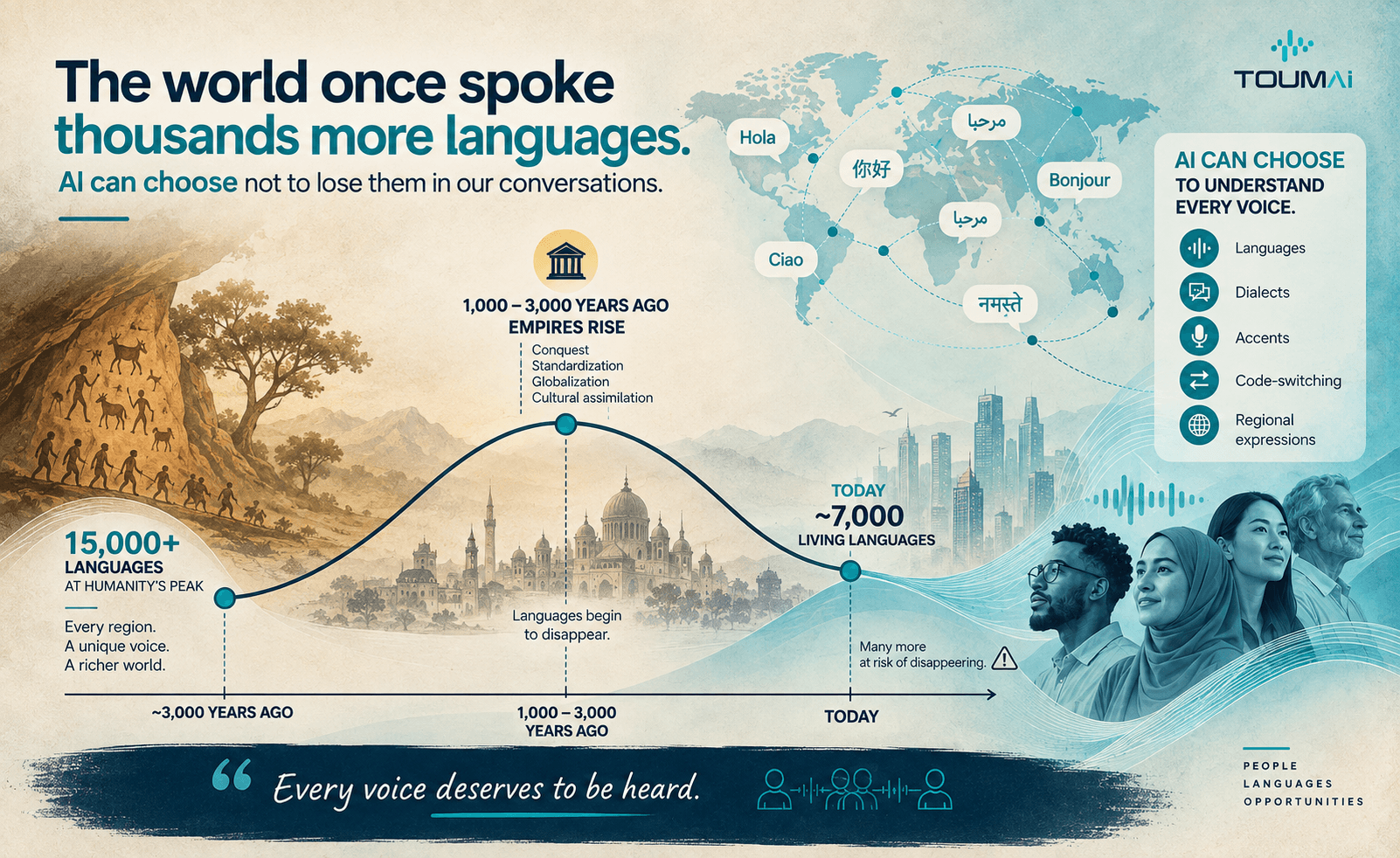
It is in this context that ToumAI has developed a unique model for understanding regional dialects trained specifically on Moroccan Darija, Khaleeji, Tunisian Arabic, Flemish, Catalan, and Swahili, and integrated directly into its voicebots.
Tip #1: Use VoiceBots With Customer Personalization
In a world where interactions between customers and businesses are increasingly digital, bot personalization emerges as an essential element to improve customer experience. Bots can be customized to meet the specific needs of your business and your customers. One of the keys to improving customer satisfaction is to make interactions with bots as natural and personalized as possible. We recommend opting for virtual assistants that can recognize customers by name, understand their preferences, and adapt responses based on their interaction history. The more personalized the experience appears, the more relevant it is and the more satisfied customers will be.
Functioning of Personalization
The personalization of bots is based on the collection and analysis of customer data. This data is used to segment users into groups based on their preferences, past behaviors, and other characteristics. When a customer interacts with a bot, information from their profile adapts the bot's responses, recommendations, or actions in real time. This personalization can draw on elements such as purchase history, geolocation, age, or product preferences.
Benefits of Personalization
The personalization of bots offers multiple benefits. It improves the customer experience by responding specifically to the needs of each individual, enhancing satisfaction and loyalty. It also increases the efficiency of interactions by reducing communication errors and providing relevant information more quickly. Finally, it promotes better conversion by allowing the bot to suggest products or services adapted to the customer's preferences, contributing to business growth.
Personalization of bots is therefore a powerful lever to transform and improve the interaction between businesses and their customers. By adapting responses in real time to individual needs and preferences, bots offer a more engaging and efficient customer experience.
The more personalized the experience feels, the more relevant it is and the more satisfied customers will be.
Tip #2: Opt for Maximum Accessibility of Your Bot
It is important that the bots you choose are always accessible easily, and for everyone. Some points to consider:
● Uninterrupted service - customer needs are not limited to office hours. 24/7 availability lets bots respond to requests at any time, even outside traditional opening hours, regardless of where the customer is. Whether it's a question late at night, on a weekend, or on a holiday, uninterrupted service significantly improves customer satisfaction by demonstrating a commitment to their comfort and convenience.
● Flexibility for customers -each customer has their own communication preference: some prefer chat, others voice messages, others a voicebot, and some like to switch from text to voice depending on the complexity of their question. Bots should be available on different channels chat, voice, social networks, email so customers can choose the method that suits them best at a given time.
● Seamless transition of conversations - a customer may start a conversation via chatbot, then need more detailed help and switch to a voicebot or a human agent. Making that transition seamless without losing conversation history or making the customer repeat themselves significantly improves the efficiency of interactions and customer satisfaction.
● Optimization of resources - bots are particularly effective at managing simple, repetitive requests. By being available 24/7, they handle a wide range of common questions without requiring a human agent, freeing up time and resources for more complex, higher-value cases.
In conclusion, making bots constantly accessible across various communication channels offers a more satisfying, flexible, and efficient customer experience. This meets the growing expectations of customers for instant, personalized assistance, strengthening the relationship between the business and its clients. By combining continuous availability with the versatility of channels, businesses can create a top-tier customer experience that stands out in an increasingly convenience and accessibility focused world.
Tip #3: Collect Customer Feedback
Collecting feedback at the end of an interaction with a bot is a crucial step to assess performance and customer satisfaction. To do this, it is recommended to set up an effective data collection process following each interaction with a bot. Here's how this can work:
● Post-interaction surveys -after each interaction with a bot, customers are invited to answer a brief survey to evaluate their experience.
● Assessment of Key Performance Indicators (KPIs) - to properly measure performance, it's important to have AI that collects data and runs analytics in parallel with bot interventions. Interactions should be evaluated against specific KPIs bot response time, accuracy of responses, problem resolution rate, transfer rate to a human agent pulled into an analytics dashboard for quick visualization of bot performance and customer feedback, including sentiment analysis and key topics.
● Human check of satisfaction - alongside automatic data analysis, it's recommended to have a team or process in place to manually evaluate customer satisfaction. Satisfaction interviews help you learn more about how customers actually feel about your bots, and often surface new problems and improvement opportunities that automated metrics miss.
In summary, collecting feedback and evaluating bot performance are essential to ensure continuous improvement. Companies can thus ensure that their bots provide a high-quality customer experience and efficiently meet the needs of customers. By using an analytics dashboard and integrating human control of satisfaction, businesses can take proactive measures to constantly improve their bots and strengthen customer satisfaction.
Conclusion on VoiceBot for Customer Satisfaction
In conclusion, bots are powerful tools for improving customer satisfaction thanks to their 24/7 availability, personalization, and ability to provide quick and accurate responses. By understanding how they work and integrating them into an omnichannel approach, you can strengthen the relationship with your customers and ensure an exceptional customer experience. Don't forget to collect customer feedback to continuously optimize your chatbots and voicebots, and maintain high levels of customer satisfaction.