Inclusive by Design: How Voice AI Is Reshaping Customer Service for Every Sector
From a customer who speaks only a local dialect to one who can't type a single word, millions of people are quietly excluded from customer service every day. Here's how Voice AI is closing that gap across every industry.

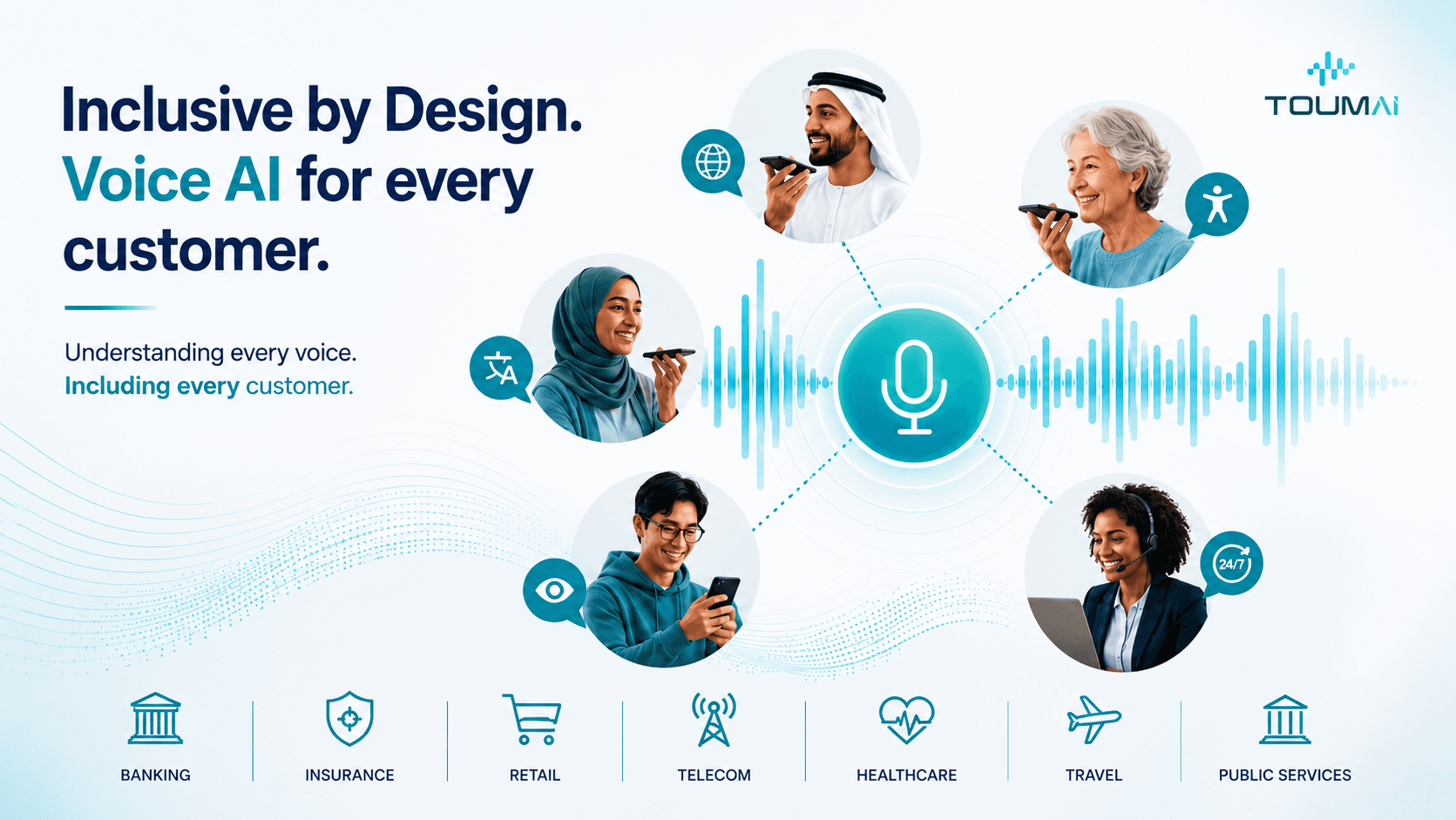
Inclusive by Design: Voice AI for Every Sector
The Customers Who Get Left Out
Every business likes to say its customer service is "for everyone." In practice, most of it isn't.
It's built for people who speak the right language, type comfortably, read fine print without strain, and call during business hours. Step outside any one of those assumptions you speak a dialect instead of the "official" language, you find typing difficult, your eyesight isn't what it used to be, or you just need help at 11pm and the experience quietly gets worse.
That's not a small edge case. Add up expatriates, dialect speakers, elderly customers, people with visual or motor impairments, and anyone who's ever felt talked past by a scripted chatbot, and you're not describing a minority. You're describing a large, often invisible share of every company's customer base.
ToumAI is specifically dialect-aware. It is one of the few technologies built to close that gap directly, across every sector that talks to customers: banking, insurance, retail, telecom, healthcare, travel, and public services alike.
Linguistic and Cultural Accessibility
Globalization didn't just connect markets; it connected languages, accents, and dialects that were never designed to run through the same customer service system. For any company operating across regions, offering consistent, inclusive support to a linguistically diverse customer base is a genuinely hard problem.
For expatriates and new arrivals, the mismatch is immediate. Someone who has just moved to a new country, or simply isn't fluent in the local language, often can't get real help if support only exists in one language. Traditional chatbots built around scripted flows and a handful of supported languages tend to fail exactly the people who need the most patience.
ToumAI changes that equation. A voice system that understands and responds naturally across languages lets a customer feel met on their own terms, not filtered through a menu that was never built with them in mind.
For dialect speakers, the gap is often even wider. In many regions, the language people actually speak at home Moroccan Darija, Maltese, LATAM Spanish, a regional variant of dialects isn't the "standard" language a company's systems were trained on. Customers who speak only these dialects can end up functionally excluded from support that assumes everyone sounds the same. Voice AI trained on real linguistic variation, not just the textbook version of a language, can recognize these dialects and route the customer straight to the right service no menu-hopping, no repeating themselves in a language that isn't theirs.
Access for Customers Who Can't Read, Type, or See Well
Language is only one barrier. For a significant number of customers, the barrier is the interface itself.
Illiteracy and low reading confidence. Navigating a website, parsing an FAQ, or typing out a problem in writing assumes a level of comfort with text that not every customer has. For someone who struggles with reading or writing, that assumption alone can make "self-service" impossible. Voice removes that requirement entirely. Customers describe what they need and get an answer back the same way, no writing required. That single shift opens up services that would otherwise stay out of reach: online shopping, checking a bank balance, resolving a billing issue.
Physical and visual disabilities. For customers with visual impairments or motor disabilities, a beautifully designed app or website can still be a wall. Voice AI sidesteps the interface altogether. A visually impaired customer can ask a voice assistant to read out product details, walk through a purchase, or check an account balance, no screen dependency required. Someone who finds a keyboard or mouse difficult to use can resolve an order issue, ask about a service, or get support entirely by speaking. It's not a workaround; it's a direct, unmediated way to get help.
And because voice systems don't run on business hours, this kind of access isn't limited to 9-to-5. A customer with a manual disability doesn't have to wait for an agent to be free or plan their day around a call center's opening times to get something resolved.
Personalization, Not Just Recognition
The real power of Voice AI isn't just that it understands a customer it's that it remembers and adapts to them.
A well-built voice system doesn't treat every call as a blank slate. It can recall past interactions, recognize a returning customer's preferences, and adjust its tone based on how the person actually sounds frustrated, rushed, confused, or calm. That's the difference between "recognizing words" and genuinely personalizing a conversation.
Older customers feel this difference most clearly. Many are wary of new technology, not because they can't manage it, but because most of it wasn't designed with patience in mind. A voice assistant that can guide someone through an order at their own pace, answer the same question twice without friction, and simply speak like a person rather than a script turns "intimidating technology" into something closer to a helpful conversation.
Where This Falls Short For Now
It's worth being honest about the limits here too. Even the best Voice AI systems don't yet catch every subtlety of every dialect or accent strong regional variation and local jargon can still trip up recognition. Culturally appropriate tone, intonation, and rhythm vary enormously across languages, and getting a voice bot to sound genuinely natural in all of them is an ongoing challenge, not a solved one.
That doesn't make the technology less valuable; it makes the goal clear. The companies getting this right aren't chasing a perfect system; they're steadily closing the gap between who their service was built for and who's actually calling.
ToumAI's Role in Closing the Gap
We've seen this gap up close, which is why we built ToumAI around it. There was no "primary" language in our design every voice mattered from day one. We started in EMEA, where switching between languages and dialects mid-sentence isn't unusual; it's just how people talk. Moroccan Darija, Maltese, regional French, LATAM Spanish, a dozen dialects, LATAM Spanish none of that is an edge case for us. It's what our systems hear and learn from every single day.
So when a customer speaks in their own dialect or regional accent, ToumAI understands it and routes that customer just as smoothly as someone speaking standard French or English. No menus asking them to pick a language. No being told to repeat themselves in something more "supported." Just a system that meets people the way they actually speak.
ToumAI listens instead of asking someone to type or read, works around the clock instead of business hours, and picks up on tone, not just words, so fewer customers slip through the cracks of a system that wasn't built for them, and more feel like someone's actually listening from the first word.
Built to Include, Not Just to Automate
Across every sector banking, insurance, retail, telecom, healthcare, and beyond the same pattern holds: customer service quietly excludes people who don't fit its original assumptions. ToumAI, built with real linguistic and human diversity in mind, is one of the clearest ways to close that gap.
Discover how ToumAI Analytics is helping companies across every sector deliver multilingual, dialect-aware, and genuinely inclusive customer experiences.