Voice AI for IVR: Building Customer Service That Actually Includes Everyone
Dialect-aware voice AI is closing the gap between performance and impact in customer service, reaching expatriates, dialect speakers, and customers with disabilities that scripted chatbots leave behind.

Voice AI for IVR: Building Customer Service That Actually Includes Everyone
Closing the gap between performance and impact, one conversation at a time.
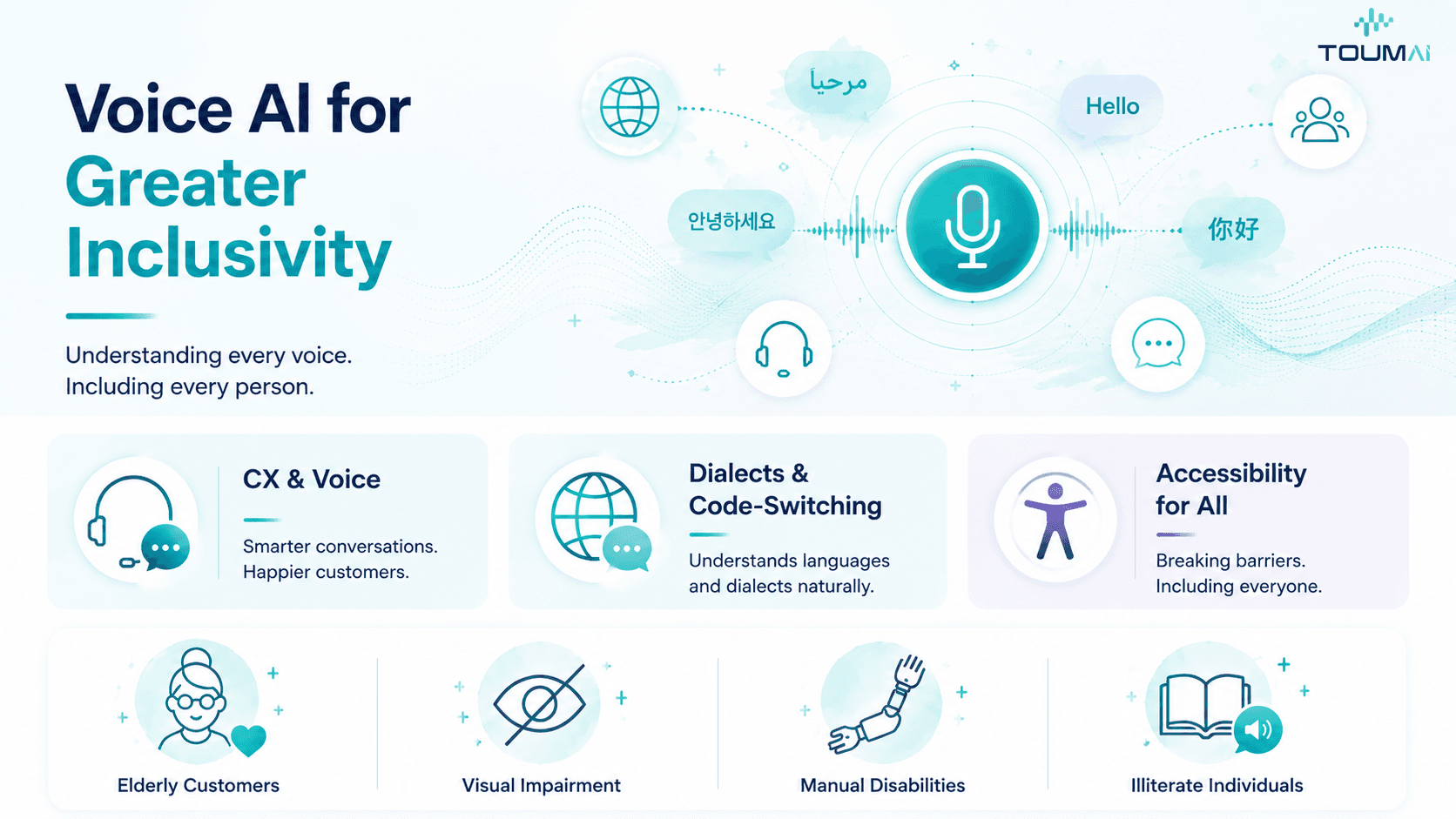
Dialect-aware voice AI in customer service centers is changing what "inclusive" actually means. These systems capture requests in a customer's own language and dialect, not a scripted approximation of it. That does two things at once: it streamlines operations for the business, and it gives customers who are often left out of standard service a way in.
Linguistic and Cultural Accessibility
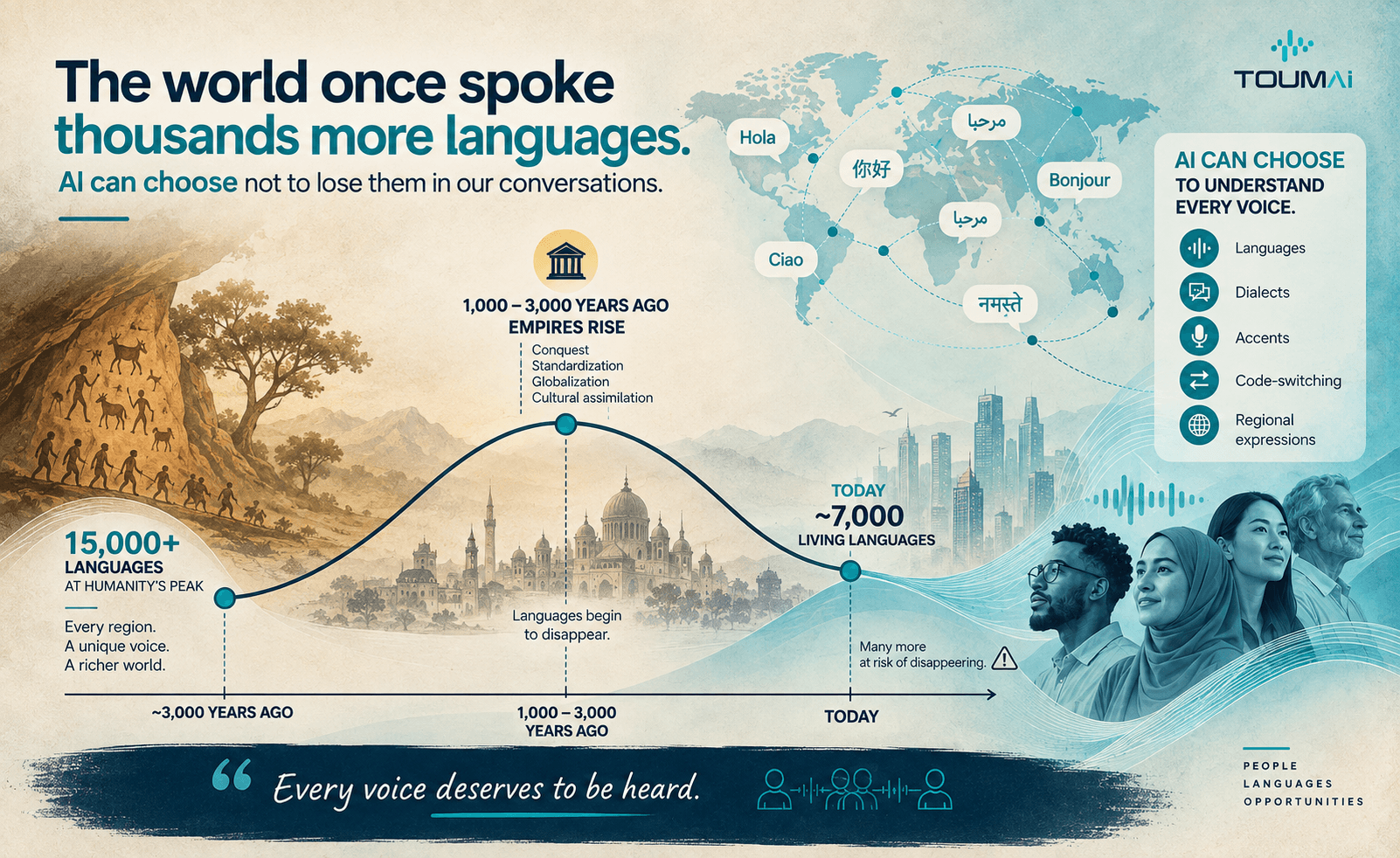
Globalization moves faster than most customer service stacks can follow. A company operating across EMEA, with priority markets in Morocco, France, the Gulf, and wider Europe, cannot serve every customer in one language and call it inclusive.
Customer Satisfaction for Expatriates
An English-speaking or Mandarin-speaking customer who has recently moved to France may struggle with a service line available only in French. Traditional chatbots, built on scripted flows and a handful of supported languages, were never built to flex.
Dialect-aware voice AI changes that. A system trained to recognize and respond in Spanish, French, Mandarin, and other major languages lets customers feel understood in their own words. For international companies, that is not a nice-to-have. It is the baseline for personalized service worldwide.
Access to Services for Dialect Speakers
In many EMEA markets, dialect matters more than the official language on paper. A bank in Morocco doesn't need standard Arabic, it needs Moroccan Darija. A telecom operator in Malta needs Maltese, not a generic Arabic or Italian model stretched to cover it.
This is where dialect-aware architecture earns its name. Fine-tuned on dialect-specific data, it captures code-switching and regional phonology that generic models miss entirely. A voice system built this way can route a Moroccan Darija or Maltese speaker straight through the IVR to the right service, no translation layer, no guesswork.
"The major platforms support languages. We support dialects. That's not a feature difference, it's an architectural one."
Assistance for Illiterate Individuals
For customers who cannot read or write comfortably, a website, an FAQ page, or a written chat exchange is a wall, not a door. Voice removes that wall. Customers speak their need and get a spoken answer back, no forms, no navigation. That opens up banking, online shopping, and support that would otherwise stay out of reach.
By removing physical barriers to communication, dialect-aware voice AI ensures that all customers, regardless of ability, get a smooth and satisfactory service experience.
Assistance for Individuals with Physical Disabilities
For customers with visual impairments or manual disabilities, voice AI replaces devices and interfaces with something simpler: speech.
Inclusion for Visually Impaired Individuals
A visually impaired customer can ask a voice agent to read product details, walk through a purchase, or check an account, no screen required. In e-commerce, where support often defaults to chat or email, this matters. A customer with an order issue can describe the problem out loud and get a refund process started or an order status on the spot.
A Different Path for Individuals with Manual Disabilities
Typing and clicking are not universal. For someone with a manual disability, a form or a chat window can be the actual barrier to getting help. Voice agents remove the keyboard and mouse from the equation entirely. Customers speak their request and get a response, whether that's product information, order status, or account help.
Voice agents also run around the clock. Customers with manual disabilities are not left waiting for business hours or agent availability. That availability is empowerment, not just convenience.
Personalizing Service for Each Customer
Compound AI architecture, speech recognition, understanding, emotion detection, and voice synthesis in one pipeline, gives voice agents more than words to work with. They learn from prior interactions and adapt to context: purchase history, prior questions, even the sentiment in a customer's voice. A voice agent can recall a past order, suggest something relevant, or shift tone based on how a customer sounds. That is customer-centricity built into the architecture, not bolted on.
Support for Older Adults
Older customers are often the first ones left behind by new technology. Voice AI meets them where they already are: talking. A voice agent can walk an older customer through an order, answer product questions, or guide account navigation at their pace, patiently, without forcing them through an app they didn't choose.
The Honest Limits
Dialect-aware voice AI has come a long way, but it isn't finished work. Strong regional accents and local jargon can still cause misunderstandings. Getting tone and rhythm right, the non-verbal parts of communication, remains a genuinely hard problem, and it varies by culture as much as by language.
That's not a reason to wait. It's a reason to keep building with accountability: measuring accuracy dialect by dialect, market by market, instead of claiming a universal fix that doesn't exist yet.
Where This Is Going
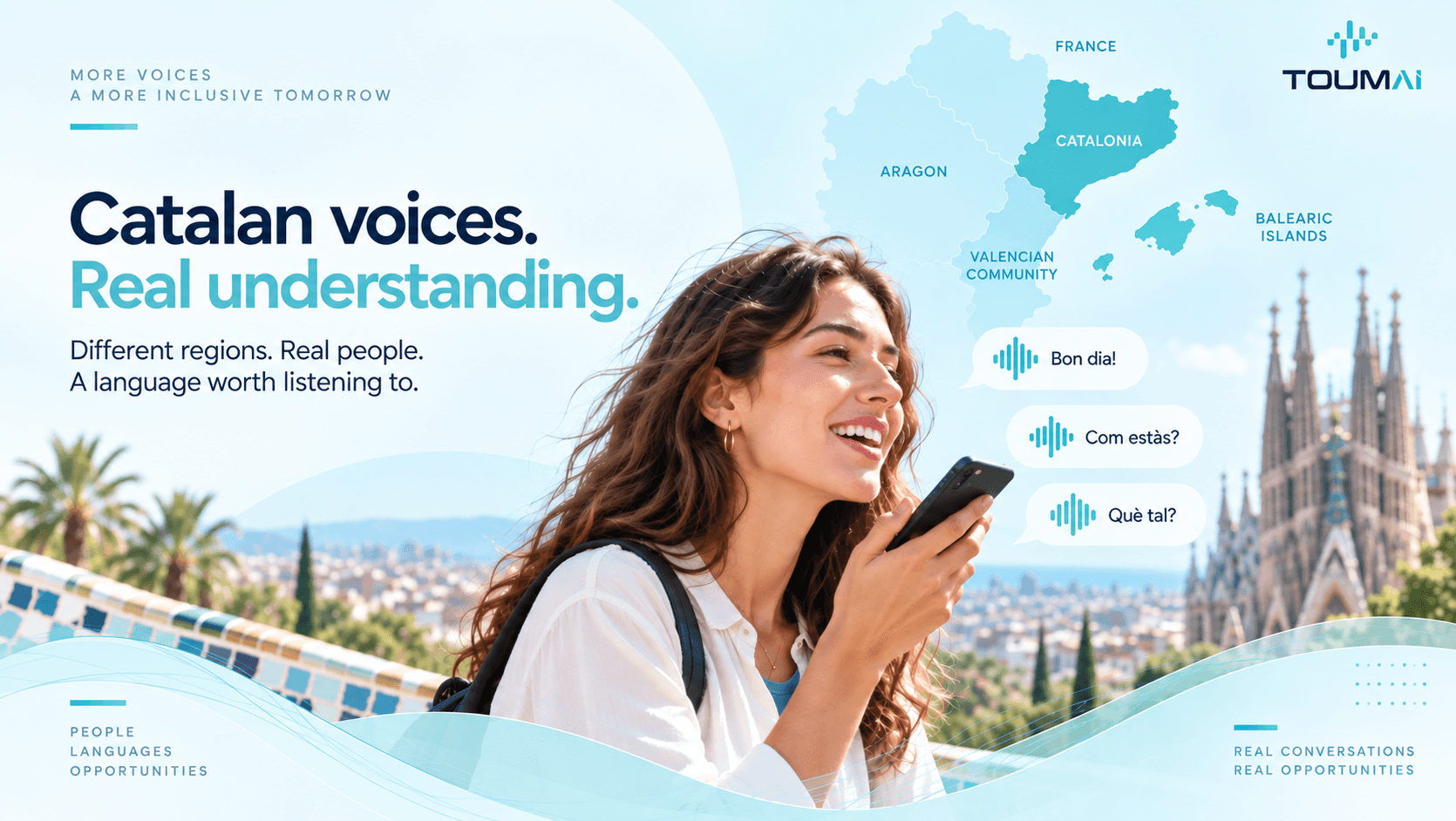
Inclusive customer service across EMEA means building for Moroccan Darija, Tunisian Arabic, Algerian Arabic, Khaleeji, Maltese, Catalan, Georgian, Flemish, and every other dialect a real customer actually speaks, not a shortlist of major languages. That's the architecture ToumAI builds on: AnalyticX for call-quality monitoring across every call, in any dialect, and AgenticX for multilingual voice agents handling real customer conversations, both on the same dialect-aware, compound AI foundation, deployable on-premise or in the cloud for data sovereignty in banking and telecom.
DVoice, our open-source initiative for under-resourced dialects, built with community data and a UNDP collaboration, is where inclusivity becomes something you can actually measure, not just a line in a brand deck.